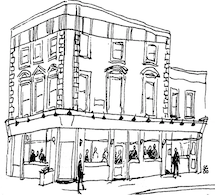

This sunday evening we hosted a group of London based photographers for an exhibition of their work. A really good evening, the place was packed, Barry Dunnage spoke on ‘Image and Truth”. Liz has lots of pictures from the night here
COTC Pub sign

I was thinking today about what image I would like for our new pub sign outside church. How about an iconic Jesus image in the style of the Angelic, or how about doing something in reaction to that.
One of my favorite images is Banksy’s Fallen angel
How about this for our pub sign?
Sunrise
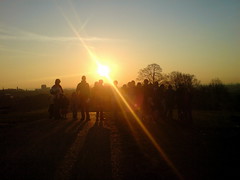
We had a beautiful Easter, from the solemnnity of our service of shadows, watching the excellen and thought provoking Jesus of Montreal on Saturday night, watching the sun rise on Hampstead heath on easter morning and a lovely all age service after a fine breakfast.

Ex Libris COTC

As we look to develop the Cloudsley room at COTC (as the upstairs end room is
now known) as a place for reading, study and prayer I thought it
would be good to develop our Library. There are lots of good books at
the moment, but on the whole they are cast offs. So instead of people
donating their old books I thought it would be great to get you all
to donate your favorite book.
Why not look at your bookshelf and decide which is the book that has
meant the most to you, and donate it to your family at church (if you
can’t live without it you can buy it again – it must be worth it!).
And better still why not write a review of it to encourage others to
read it.
I have made a little ‘ex libris’ card which you could print out and
stick inside the front, which has room for a brief review. If you
want to write something longer, why not tuck that into the book too.
We will select some of the best reviews and display them on the shelf
(like in Waterstones) .
Old Paths – Thomas Cranmer
We are coming to the end of this series, and though there are many amazing figures of recent church history I would love to cover we will just choose some of the key ones. Last night we told the story of Thomas Cranmer, Archbishop of Canterbury, architect of the Church of England and Martyr for his faith.
The video of his words and wisdom is above, his recent Biography by Diarmaid MacCulloch is excellent or you can listen to a lecture on the occasion of the 450th anniversary of his death by my old church history lecturer (yes it is all his fault!) from Bible College.
Old Paths – Martin Luther

More has been written on Martin Luther than any other figure in Church History. He stands between the medieval and modern worlds, and on one of the great faultlines of Christianity, and his thinking defines protestant theology to this day.
Lots of good online media on the subject. Melvin Bragg on Radio 4’s ‘In our time’ discussing Luther at the Diet of Worms. There is the webpage of a US TV series on Luther with a dramatic introduction to the man and some interviews with people including Alistar McGrath. An interesting listen is David Starkey’s abject attempt to suggest that Luther killed christianity which is shot down by his own witnesses.
Old Paths – Thomas Aquinas

Scholar, mystic, politican. You can download the whole of his epic ‘Summa theologica’ here. But perhaps just a taste is all you need – here is his ‘Sacred Doctrine’
Francis of Assisi

Francis of Assisi is well known for his love of nature and his simple peaceful lifestyle, and his founding of the radical Franciscan order of Monks. He is one of the most Christlike figures in History, but the aspect of his life which is more pertinant to our day than any other is his relationship with the world of Islam. A good introduction here
The cost of life

I found this excellent ‘game’ today. I say ‘game’ because actually it is a bit traumatic. You have a little family who you need to keep alive, feed and educate. And it is really hard. They kept dying on me. It is sponsored by unicef and if has a very serious point about how hard life is in the developing world – and just when you think you are doing ok disaster strikes. Have a go and tell me how you do. I was beginning to thing it was rigged, but it turns out you can do okay: All alive, 2577 goud and 6 diplomas – beat that!
The Last Sunday

Sunday night was quite memorable. It was the next in our ‘Last Sunday’ services and we spent the evening as a meditation on communion.
It went something like this:
Opening prayer
Reflection on Bread including a reading from John 6
Making Bread. We had mixed the dough, but it still needed kneading and shaping. During the breadmaking we shared our experiences of communion – both good and bad. Then the bread was taken off to be baked.
Reflection on Wine. There was wine on the tables and we discussed the biblical imagery of wine – as new life, joy, abundance and peace. During this part the smell of baking bread drifted through the room.
A short talk on the importance of the ritual, incorporating some of the historic conflict over communion and an encouragement to take this back as part of our community life.
Then the bread was brought out again, and we used it for communion. Lovely.
Benedict of Nursia

Benedict left his comfortable life in the city at a young age to pursue his relationship with God in the wilderness. Three years of solitude profoundly changed him, his understanding of humanity and of himself and of God.
Gradually others came to join him in the wilderness and as the community grew he found it necessary to develop a rule of monastic life, full of spiritual and practical wisdom for christian communities which profoundly shaped not only the spiritual life of western europe but also its politics. In an age when government was by force in these communities the Abbot was chosen by the monks and ruled the community in accordance with the written rule and in consultation with the monks.
As a contemporary introduction to the rule of Benedict I would highly recommend the book Finding Sanctuary (£4.50 from Amazon). One of the aspects which I found particularly helpful was Benedicts 12 steps of humility.
Old Paths: Augustine

Really enjoyed preaching on St Augustine yesterday. I am struck that one of the really important aspects of this series is that we see great figures of the past as they really are, and avoid the natural inclination to put people on a pedestal. Augustine is one of the greats, but he is also very human. And perhaps it is his awareness of his own failings, along with his ability to wonder that makes him so important.
For further reading there is a short biography here, and here is a modern translation of City of God, and here is Confessions. They are quite long though and you might want to pick them up in a 2nd hand book shop or from Amazon. The wikipedia article on him is not so good – I think people are fighting over him (the down side of wikipedia) and it is a bit scrappy.
Oh and check out this free download of Malcom Muggeridges ‘a third testament’. The first chapter is on Augustine.
Old Paths: Tertullian

Tertullian was a theologian and fierce defender of orthodoxy. He articulated an elegant and sophisticated doctrine of the nature of God and coined the term Trinity. His influence on Christian thinking is enormous, but also very significant was his gradual rejection of the Greek philosophical culture which the early church was formed within.
You can read a brief biography of his life here [though with a rather more positive interpretation than mine], and find his surviving works and more in the excellent Tertullian Project
I was struck in studying Tertullian (ironically) by the importance of heresy to sharpen and refine orthodoxy. If it had not been for the views of people like Marcion and Arius this elegant articulation of the Trinity may not have come into being. The church has tended to try to lock down orthodoxy through fear of error, but it is that very struggle for truth which spurs us to understand and better articulate what we know of God.
Old Paths: Justin Martyr

Our new teaching series starts this week. It is called ‘Old paths’ and we will be tracing the course of church history through the lives of those who have gone before us.
“Though their culture and language seem alien to us, the same call of Jesus echoes in their ears, and the same spirit works in their hearts”
The first is Justin Martyr, who lived from around 100AD to 165AD and wrote bravely in defence of Christians and their faith in a time when such belief was brutally oppressed. For further reading his surviving documents are all available online. The excellent ‘To the Emperor Titus Aelius Adrianus Antoninus Pius Augustus Caesar’, his second apology To the Roman Senate and the Dialogue with Trypho. There is an excellent wikipedia article on Justin too.
The poor in spirit…

We start pub theology again tonight, same place, same time. We are going to start back at the beginning of the beatitudes – Jesus opening sermon and his manifesto. Blessed are the poor in spirit, for theirs is the Kingdom of God.
Finding Sanctuary

In home groups we are studying this book written by Abbot Christopher Jamison from Worth Abbey.
It is a beautiful little book full of gentle wisdom and practice about making space for God in the midst of busy modern life.
You can buy it for a bargain £4.50 from Amazon
Christmas at Church on the Corner

Happy Christmas everyone.
How to speak of things beyond words
A little reflection on John for the carol service at church tonight. The lights are on the South Bank, the music is ‘The Light’ by The Album Leaf. By Jeremy
Reflections on Galatians

It felt like an important momant for us tonight, looking back on our time with the Epistle to the Galatians. The conversation we had about how to take what we have learned and put it to work in our community was good, and I want us to hold those things and continue to pursue them.
The things which I distilled from today were these; please add to them what was important to you:
The thing that counts is faith expressing itself through love. Church should be the place we come when we feel our brokenness rather than where we have to pretend to be fine. The call is to carry one another’s burdens and to share in that struggle.
Our experience of brokeness and conflict is not a mark of our failure but evidence of the spirit of God at work in us. Let us learn to be more honest with each other. We should change our expectation and declare that the norm is struggle and dissonance.
Keep in step with the spirit. We are a spiritual community, and we need to learn to speak of spiritual things in our own language. We walk together and share in the adventure of knowing God. Let this be the place where we talk of our real experience of God without fear of not being correct.
We intend to take sin more seriously not less. Sin is not some outward contamination which can be washed away, but something innate in our nature, something which we will fight with all our days. And we will take grace more seriously. The mercy of God does not come to an end once you become a Christian.
The first rule of pub theology…

is that you don’t talk about pub theology.
Er no, that was fight club.
The first rule of pub theology is : Nothing is sacred. Question anything, don’t get offended if someone questions your ideas.
The second rule is: Hard on ideas, soft on people. We deal robustly with the subject matter, we deal respectfully with each other.
 Church on the Corner
