
An old friend of mine from vicar factory has been appointed to a new job in Brighton, and is being supported by the diocese to plant a new type of church in the city centre. They are meeting in a pub, and have a focus on the sort of people who would not normally go to church (sound familar?) They have a website here: Christ Church Brighton . Please pray for them – I am sure these first months will be hard but exciting.
Chaos Theology: Power

“The world itself is the will to power – and nothing else! And you yourself are the will to power – and nothing else!”
Friedrich Nietzsche.
A right theology of power understood through the Bible narrative and exercised in our real lives is the intention of this sermon. We all have mechanisms for dealing with the use and abuse of power, but I suspect that we don’t always recognise them or express them coherently. Power, whether at work on the global scale or in our own relationships needs to be understood and used for good not evil. And Jesus astonishing relationship with his own power is a unique point of engagement with a world obsessed with power. This fourth talk in our chaos theology series can be found here. If you have comments or thoughts add them below.
An A to Z of Alternative Worship
This is a lovely piece of work on aspects of creative worship, even if it starts a bit cheesily. A is for Ambience, good. B is for Beanbags… hmmm.
Bible, bravery or brokenness would be my immediate suggestions. I like K is for kleptomania and G is for Graceful particularly.
Chaos Theology : Wealth

What are you worth? What is it that makes us rich? We are treading on dangerous ground when we raise questions about wealth and money, and a working theology of wealth is not going to be easy. But it is the subject that Jesus talks about more than any other than the kingdom of God itself, and our christianity is shallow if it doesn’t effect our attitude to wealth.
The sermon in our series can be downloaded here. Comments and questions below!
Billboard Jesus

You might have spotted on the BBC website the new christmas poster campaign by the Churches Advertising Network continuing the revolutionary theme from the che guevara poster. There is a Q&A about it here. What do you think? Not your conventional christmas image. I am kinda liking it.
Meaning

The second sermon on our Chaos theology series, on the theme of meaning from last night can be found here
beingyourself.info
Jeremy just sent me the link to his new work site at beingyourself.info which is a fantastic looking mission project based on Psalm 139, and the toolbox page which explains how to use it. SGM (Scripture Gift mission) is apparently going through the process of reimagining its identity and methods to better serve the gospel in an information age. Exciting stuff.
Getting out there
‘Start with Church and the mission will probably get lost. Start with mission and it is likely that the church will be found’
Mission shaped Church 2004
The subtext to our attempts to do real world theology this term is the conviction that we are to be an urban church, engaged with the lives and ideas that form our city. John Stott said many years ago that the work of proclaiming the Gospel required dual listening; listening to God, and listening to Culture. We intend to prioritise that this term and beyond.
One of the ways that will happen is through homegroups, where we are combining a series on the early church discovering its mission, with some recommended reading.
Below are links to some of the books we are suggesting. Have a flick through and choose one that appeals. If you have already read one of these perhaps try something else. Any other suggestions of good books?


Out of the Saltshaker A thoughtful and at the time groundbreaking approach to relational evangelism. The Shaping of things to come; fascinating and sometime uncomfortable work on church and mission. Emerging Evangelism John Finney’s excellent book on theory and practice for 21st Century mission. Know and tell the Gospel. Australian John Chapman on good form with a clear and simple approach to telling the Gospel
Identity

The opening sermon of our Chaos Theology series is now online. The theme is identity. You can find the Beauty in the Breakdown video here and the sermon audio is here.[Sorry about the quality – working on that]
Chaos Theology
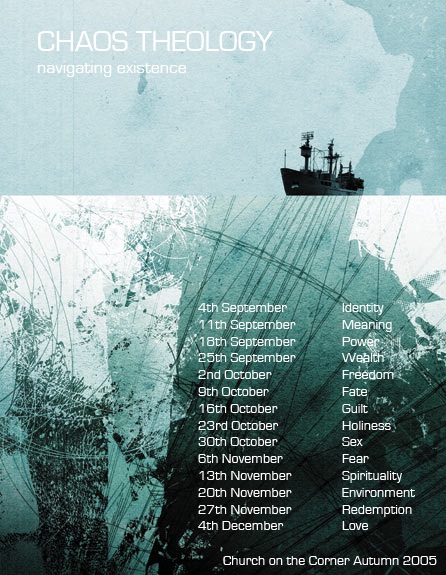
I am excited and a little nervous about our teaching programme for this Autumn. We are thinking about big issues. The principle behind it we introduced at the end of last term, that the next step for Church on the Corner is to step outward and to engage with the culture that we are part of. And to do that we need not only to understand the Gospel, but to understand our culture too.
This series, inspired by some of the central themes of life observed in art, philosophy, literature and film aims to both inspire and equip us to see what we believe worked out through the whole of our lives, and to be better equipped for dialogue.
Chaos theology is theology for the 21st Century, the belief that in the midst of all the mess and brokeness there is meaning, connectedness and hope.
Declaration of interdependence
I realised today that the are some foundational principles that I am working on, that shape my thinking about church, but that many people may not be aware of these, or even agree with them. I love that phrase at the beginning of the US Declaration of independence ‘We hold these truths to be self-evident’ and I thought it would be interesting to express our declaration. This is just for starters, leave me comments and I will add more as we think of them.
We hold these truths to be self-evident, that all people are created equal, that we do not judge on the basis of education, wealth, appearance, gender or race.
That the church exists primarily not for the sake of its members, but rather for its non-members.
That we are part of church not for what we receive, but for what we can give.
That every member of the church is important as part of the body of Christ, and shapes who we are by their character and abilities.
Grown up christianity
1 Corinthians has been making us think a lot about freedom.
One of the tensions is the fact that freedom is risky. How much should we give people freedom to make mistakes? Lots of us are formed by our experience of being part of youth work at church, where a priority is keeping young people safe, protecting them from the dangers of being sucked into a world that they are ill equipped to handle (though maybe equipping them should be more our priority than protecting them). We want to give people clear guidelines, black and white principles which very quickly become rules.
I remembered yesterday one of the experiences of moving from studying a subject at school to studying it at University. There was a moment at the start of our study when our lecturers would say ‘remember all that stuff you were taught at school… well good though it was, things are not as simple as that’. We had to unlearn as much as we learned in those first months.
I wonder should we have the same milestones in our Christian life. Moments when we say ‘Remember that stuff you were taught in youth group or Christian Union? Well good though it was, things are not as simple as that.’
Relating to God as adults requires us to own the freedom that he gives us, and that includes the freedom to make and learn from our mistakes.
emerging church

This is one of the movements i am most inspired by. Can I recommend emergingchurch.info and also blogs by andrew jones and a friend of mine si johnson as starting points.
It is a movement shaped within postmodernity, reimagining church incarnate in the 21st century. There are many overlaps between emerging church and what we are up to at COTC
however as ever when it comes to movements i tend to rather exist on the margins (it is a personality thing).
One of the things which defines church on the corner which is different from many emerging churches, is that we deliberately exist within the anglican church, valuing much of the tradition and cultural heritage that anglicanism brings us, but doing church in a way which is intended to be prophetic both within that tradition and in the cultural milieu of London.
If there is a critisism I have of some emergent christianity it is the rearranging deckchairs on the titanic one. It sometimes seems to be about cosmetic change in church practice rather than systemic change in the hearts and minds of the people who form church communities.
I am really grateful for the work of those pioneering new models of church and worship outside the structures of establish church, and i hope we can support and learn from what they are doing.
ownership

I have had some good chats at tinderbox with people in the last week or so, and one of the themes that has struck me is that of ownership.
there is a heirarchy in most churches based on theological punching power, the more bible knowledge, the more coherent in their orthodoxy the greater status and respect.
This creates an environment where creatives and right brainers are made to feel less significant or spiritual, where as the reality is that the qualities they bring are crutial to our attempts to reimagine church. I want to grant ownership as much to these creatives as to those who feel comfortable in a church environment. I want these people to shape who we are and how we exist as church as much as the theologians and lefts brainers among us.
Here is our first attempt to do so
a prophetic church

1 Corinthians 14.
The essense of prophesy is knowing God and communicating that with others, not in second hand words, but through our own encounter with the living God.
It can be what we say and the way we live. We need to be a prophetic church, hearing and knowing God and sharing that with each other and with those outside.
Prophesy reflects the character of God, it is his spirit that brings life and truth. Prophesy is a gift of God, the ability to communicate his truth in words that people can understand.
Prophesy also requires work:
Prayer
Study
Thinking
Listening
conversation
Morning prayer
Over there on the side bar I have added links to the CofE’s orders of Morning prayer, evening prayer and night prayer
I know that for many of you the idea of liturgy is a major turn off, but I have come to really appreciate these patterns of worship. The great strength of liturgy is its greater perspective of God; it is beyond our own often limited thinking. I find prayer so often dominted by whatever is going round my brain at the time, I obsess on my own stuff when I know I should be worshipping, interceding and so on.
The depth and beauty of the language, the rich biblical and historical tradition lift me beyond myself and give me the peace that comes from seeing God as he really is, and seeing my small but significant place in his creation.
Practically I find it best to actually speak out the words and the readings, and in the pray for maybe three specific things in the part set aside for intercession. The links update each day, so you always get the set readings for that day. Sometimes there is a prayer by Saint somebody or other that confuses me, but other than that it is really good. Reading chunks of the Old testament systematically is really good too. I tend to only do one of these a day, whichever is appropriate. Try it – you may hate it, or it may really work for you.
‘And now I will show you the most excellent way.’ …
‘And now I will show you the most excellent way.’
In time of crisis, at a time when religion is hijacked for evil purposes we need to remember the essense of Christianity. 1 Cor 13 feels like such an appropriate passage to be looking at in the light of last weeks bombings.
When religion goes wrong, as it so often does, this essense which often seems so trite, a pop song cliche, ‘all you need is love’ but this is the essense we rediscover.
Love subverts the whole heirarchy of evil, corruption, violence and retribution. It defines God, and it should define the church.
The way of Jesus is the way of love. Other centred, self sacrificing, turning the other cheek, forgiving, welcoming, generous, fighting opression and the things that enslave.
This is Gods call on our church.
1 Corinthians 7
Now it gets personal. Preaching on the most controversial theological issue would be nothing compared to the potential pastoral fallout from getting wrong a sermon on 1 Corinthians 7 – Sex & singleness
What relative value do we place between orthodoxy …
What relative value do we place between orthodoxy and unity. As protestants we are defined by division, and it is hard to comprehend a call to put unity at the highest priority. 1 Corinthians 3:1-11 – Schism
We worried about the title of this sermon, that it…
We worried about the title of this sermon, that it might be in some way disrespectful, but in the end I felt it conveyed the shocking nature of the subversion of human wisdom that the passage communicates. 1 Corinthians 1:18-25 – The madness of God
 Church on the Corner
